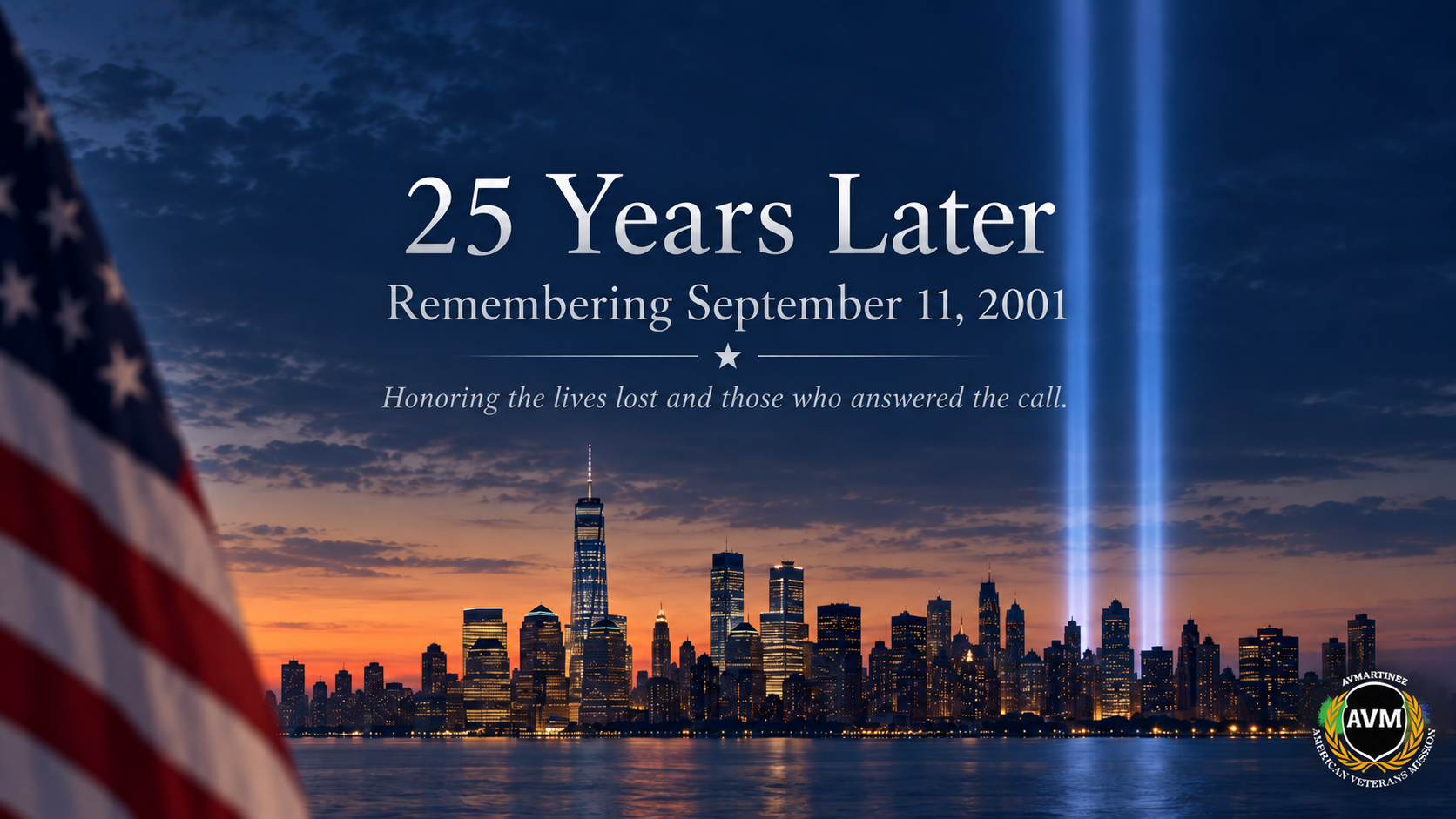
Twenty-five years have passed since the morning of September 11, 2001. For those who remember that day, the images, emotions, and uncertainty remain difficult to forget. For an entire generation born afterward, September 11 is history learned through classrooms, family stories, memorials, photographs, and the testimony of those who lived through it.
Whether remembered firsthand or learned later, the meaning of September 11 endures. Today, American Veterans Mission pauses to remember the lives lost, honor those who responded, and express our gratitude to the service members and military families whose lives were profoundly shaped by what followed. We do so with humility, respect, and a commitment to preserving the memory of those whose lives were forever changed.
On September 11, 2001, four commercial aircraft were hijacked in coordinated terrorist attacks. Two struck the World Trade Center towers in New York City, one struck the Pentagon in Arlington, Virginia, and the fourth, United Airlines Flight 93, crashed in Pennsylvania after passengers and crew fought back against the hijackers. The attacks killed 2,977 people from more than 90 nations.
Behind that number were individual lives. They were parents, children, spouses, brothers and sisters, friends, coworkers, public servants, and travelers who began what they believed would be an ordinary Tuesday morning. They had dreams, routines, responsibilities, and people who loved them, and today we remember them.
Remembering Courage in the Face of Tragedy
The horror of September 11 was met almost immediately by extraordinary acts of courage. Firefighters climbed stairwells while others were trying to escape, and police officers, emergency medical personnel, military members, transportation workers, and ordinary civilians moved toward danger to help people they did not know. Their actions reflected an instinct to serve others even when the personal risk was enormous.
At the World Trade Center, hundreds of first responders lost their lives while trying to save others. Their sacrifice has become one of the defining memories of that day, but it should never be reduced to statistics alone. Each person who responded represented a family, a community, and a commitment to duty that deserves to be remembered with dignity.
On Flight 93, passengers and crew members learned that other aircraft had already been used as weapons and chose to fight back. Their actions prevented the hijackers from reaching their intended destination in Washington, D.C. Their courage reminds us that heroism is not always planned in advance, and that sometimes courage means choosing to act when others need help most.
A Nation Answered
In the days and weeks that followed, Americans grieved together. Communities gathered, flags appeared on homes and businesses, blood donation centers filled, volunteers traveled to help, and families held one another more closely. In a time of national shock and sorrow, people across the country looked for ways to serve, support, and stand together.
Members of the United States Armed Forces also prepared to answer a different call. Many of the men and women who would later serve in Afghanistan, Iraq, and other operations around the world were young on September 11; some were already serving, while others would enlist because of what they witnessed that day. Over the next two decades, millions of service members and military families would experience the consequences of the conflicts that followed.
Some service members deployed once, while others deployed repeatedly. Families endured long separations, missed birthdays, holidays, births, anniversaries, graduations, and countless ordinary moments that could never be recovered. Some service members returned with visible injuries, others carried burdens that were less visible, and some never came home.
At American Veterans Mission, we believe remembrance of September 11 should include gratitude for those who answered that call and recognition of the families who served alongside them. Our mission is to strengthen the lives of veterans, service members, military families, and their communities through resources, partnerships, volunteer service, and programs that improve quality of life and create lasting community impact. Honoring military service, for us, means remembering not only what happened in combat, but also the people who carried the responsibility of serving and the families who shared in that burden.
Remembering the Families
Military service has never been borne by the service member alone. Behind every deployment was often a spouse managing a household, a parent waiting for a phone call, a child counting the days until someone came home, or a community stepping in when a family needed support. The sacrifices of military families are an essential part of the post-9/11 story.
The post-9/11 generation of military families carried years of uncertainty and separation. Some families welcomed loved ones home changed by their experiences, while others received news that permanently changed the course of their lives. Gold Star families continue to live with losses that cannot be measured simply by the passage of time.
Twenty-five years later, we remember them too. American Veterans Mission exists not only to serve those who wore the uniform, but also the families and communities who stood beside them. Our values call us to serve with compassion, inclusiveness, respect, accountability, and responsible stewardship.
The Meaning of “Never Forget”
“Never Forget” has become inseparable from September 11, but remembrance should mean more than recalling images from a terrible day. It should mean preserving the stories of those who were lost, teaching younger generations what happened, and honoring the courage of first responders, civilians, service members, and military families. It should also mean reflecting on the responsibilities that come with memory.
To remember is to recognize that sacrifice continued long after September 11 itself. Veterans returned home carrying the physical, emotional, and personal consequences of war, while military families adapted to repeated deployments and long periods of uncertainty. For many, the impact of September 11 has never been confined to a single date on the calendar.
As time passes, remembrance becomes an even greater responsibility. More Americans each year have no personal memory of September 11, which means that the duty to teach, explain, and preserve the meaning of that day increasingly falls to those who do remember. The values revealed in the aftermath, courage, compassion, service, sacrifice, and unity, deserve to be carried forward.
Service as Remembrance
One of the most meaningful ways to honor those who served is to serve others. Not everyone will wear a uniform, become a firefighter, police officer, paramedic, or public servant, but every person can contribute something to a stronger community. Service can take many forms, and even small acts can create meaningful impact.
A few hours of volunteer service, a meal delivered to a military family, a conversation with a veteran who feels forgotten, mentoring a young person, or helping a neighbor in need can all become acts of remembrance. These actions may seem modest, but they reflect the same principle that communities are strengthened when people care for one another. In that way, remembrance becomes something we live, not only something we observe.
American Veterans Mission believes meaningful change happens when people work together with mutual respect, shared purpose, and a commitment to serving others. That principle is especially appropriate on September 11 because the day reminds us both of profound loss and of the extraordinary service that followed. Remembrance can be quiet, reflective, and personal, but it can also inspire action.
Twenty-Five Years Later
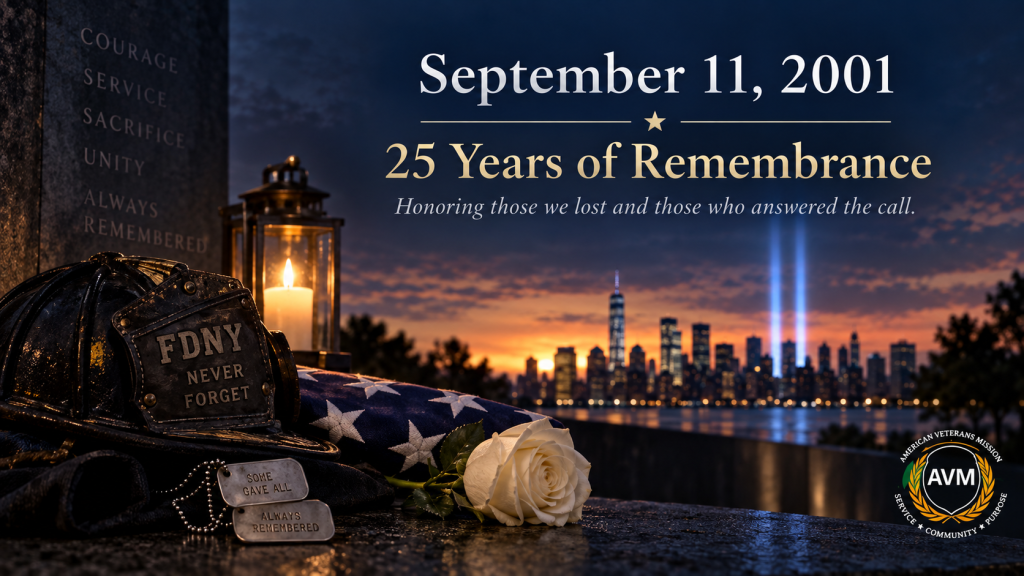
A quarter century is a long time, and the world has changed considerably since September 11, 2001. Children born after the attacks are now adults, many veterans of the wars that followed have transitioned into civilian life, and some have become parents and grandparents. Others continue to serve in uniform, public service, veterans organizations, nonprofits, businesses, schools, and communities across the country.
Yet some responsibilities should not change. We should remember those who were taken from their families that morning, honor the first responders and civilians who demonstrated extraordinary courage, and thank the men and women of the United States Armed Forces who answered the call to serve. We should also remember the military families who waited, worried, sacrificed, and endured, and support the veterans who continue to carry the consequences of that service.
We also have a responsibility to teach those who came afterward why September 11 still matters. Memory is not only about preserving the past; it is also about shaping how future generations understand service, sacrifice, resilience, and citizenship. Twenty-five years later, that responsibility belongs to all of us.
Today, American Veterans Mission joins communities across our nation in remembrance. To the families of those who were lost, we remember you; to the first responders and civilians who ran toward danger, we honor you; and to the service members who answered the call, we thank you. To the military families who served alongside them and to the veterans whose battles continued long after they returned home, we remain committed to serving you.
Twenty-five years later, may we continue to remember not only the tragedy of that day, but also the courage, service, compassion, and unity that followed. May we carry those values into the way we serve our neighbors, support our veterans, strengthen military families, and care for the communities we share. In doing so, remembrance becomes more than words.
We remember. We honor. We serve.
Together Everyone Achieves More.